Showing posts with label programming. Show all posts

Wednesday, January 28, 2009

Friqing Out with Python Closures

You have to love snow days. After spending an hour shoveling snow this morning, I fired up my lap-top for a guilt-free afternoon of tinkering around with some code. I opened up some Python code that I had coded last year when I was discovering functional programming with Erlang and relating it to languages that I was familiar with.

Python is a great language for exploration. Back in the old days I did a lot of programming using C++ and Microsoft's Component Object Model (COM). C++ COM is a fairly complex technology so I found it preferable to prototype object-oriented designs using Java. The Java language's interface mechanism was a good analog for COM's interface-based programming paradigm. Java was a sexy thing compared to COM and Java was the lingua-franca of object oriented design during this period.

Then I discovered Python and found that it featured a familar approach to object orientation and it looked like it would support rapid prototyping and concept exploration.

Python proved to be a excellent language, but it did not serve well as a prototypical language for C++ applications. In the C++ language, data types are everything. Most of the advanced features of the language, such as templates and classes, provide ways to manage functionality across data types. The C++ compiler is the ultimate master and the programmer is subjected to its rule of type.

Python cannot be used to prototype solutions to C++ problems because the problems do not appear in Python.

Most circa 2000 C++ programmer were ill-equipped to absorb Python. To absorb Python meant to be influenced and changed by Python - to refute idioms previously held sacrosanct.

To close the loop, a next logical step would be to gain perspective by relating Python to functional programming languages and not just to Java and C++.

My Python Data Structures Project

I go through a cycle every now and again that involves Python and data structures. A good data structure to code is the Priority Queue. The binary heap-based Priority Queue features a tree data structure, implemented using an array and clever array index manipulations. A binary min heap is shown below. Essential a binary heap must always be correctly ordered, children must always be greater than its parents (in the case of the binary min heap).

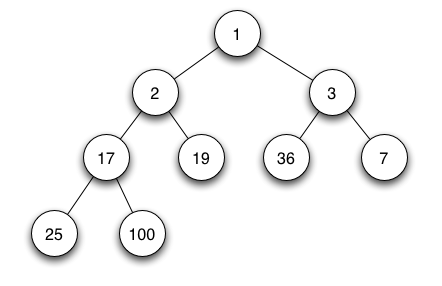
Add Image

The binary heap is stored in a simple array. Algorithms maintain the relations between array elements as shown below. One exception is that it is easier to implement the array-based binary heap if the first element is stored at index 1 in the array.


One reason to code up a Priority Queue is that it is a building-block data structure with multiple uses. The Priority Queue conceptually fits well into an abstract data type (ADT) such as a C++/Java/Python class. In fact there are Priority Queue ADTs in all three languages. My recent investigations into functional programming led me to create a Priority Queue using lexical closures. My original class-based Priority Queue was named priq. Thus the functional-closure based version became friq. And indeed it is a friq.

The friq


The screen shot above shows the definition of friq which is function with a single parameter lt. Parameter lt is a comparison "less-than" function which is easier demonstrated than explained. It will be demonstrated in the next section. Note that friq is a function definition that encloses other function definitions, and a rather strange nested list heef. The functionality exported by friq is done with its return statement (see below).


The functions enqueue and dequeue shown above are the two functions, enclosed by friq, that are exported to the outside world using friq's return statement.


Functions down_heap and up_heap implement the heavy lifting algorithms for the priority queue and are not exported to the outside world.


Finally we have the enclosing function friq returning a tuple containing the functions we wish to export.

Demonstrating the friq

The following code demonstrates usage of the friq. A list d is loaded with some random integers. The friq is invoked returning a tuple containing a function to enqueue values and another for dequeueing. List d is iterated and its values are enqueued. Then the friq is drained by dequeueing.


The usage of friq appears reasonably simple and straighforward. Note friq's lt parameter being passed a Python lambda function. The results are seen below.


Next we have a slightly more complex demonstration in which a tuple containing a number and a string is enqueued. Note that the code that handles dequeueing has to do extra work to expand the tuple. Also note that the lambda function is slightly more complex in order to handle the tuple. The index 0 signifies that the sort will be on the tuple's number.


The next demonstration is identifical to the previous with the exception that the lamda function uses an index of 1 which signifies that the sort will be on the tuple's string.


And finally, a display of the results of both demonstrations that involve the (number, str) tuple.


Here is the complete listing of friq.py


friq.py

#! /usr/local/bin/python

def friq(lt):
"""
function friq that returns lexical closure function objects.
param lt - a 'less than' function or lambda
"""
heef = [[None]]

def enqueue(x):
"""
enqueue - visible function
Add to the priority queue
"""
heap = heef[0]
heap.append(x)
up_heap(heap)

def dequeue():
"""
dequeue - visible function
Get the highest priority elemement
"""
value = None
heap = heef[0]
if lenf() > 0:
# The dequeue value is taken from the 2nd element in the array.
# The first element is not used to ease index arithmetic.
value = heap[1]
if lenf() > 1:
# The last element value is copied to the first position.
heap[1] = heap[-1]
# The last value is deleted to reduce the size of the pq by one.
del heap[-1]
if lenf() > 1:
# The val at heap[1] is moved down heap to maintain order.
down_heap(heap)
return value

def heap():
"""
heap - non-visible function
Returns the underlying array-based binary heap.
Can be made visible for debug.
"""
return heef[0]

def lenf():
"""
lenf - non-visible function
Returns the size of the underlying array-based binary heap.
Can be made visible for debug.
"""
return len(heef[0]) - 1

def down_heap(heap):
"""
down-heap - non-visible function
The first element is moved down heap as required
to satisfy heap order.
"""
# px is an index to a bi heap parent
# cx is an index to a bi heap child
px = 1
v = heap[px]
while px <= (len(heap)-1)//2:
# calc the index of the child
cx = px + px
# find the index of the min of the two children
# (if there are two).
if cx < len(heap) - 1 and \
lt(heap[cx + 1], heap[cx]):
cx = cx + 1
# make the comparison - if v is higher pri - we are done.
if lt(v, heap[cx]):
break;
else:
# move the childs value to the parent
heap[px] = heap[cx]
# make the parent index that of the child.
px = cx
# finally the v is set to the current parent
heap[px] = v

def up_heap(heap):
"""
up-heap - non-visible function
The last element is moved up heap to satisfy the heap order.
"""
# cx//2 idenifies cx's parent in the bi heap.
cx = len(heap) - 1
v = heap[cx]
while cx//2 > 0 and lt(v, heap[cx//2]):
heap[cx] = heap[cx//2]
cx = cx//2
heap[cx] = v

# the enclosing function returning functions that are to be visible
return (enqueue, dequeue)

Wednesday, December 26, 2007

Erlang and the Towers of Hanoi

My brilliant, 15 year-old son is teaching himself how to program Ruby using Chris Pine's wonderful book, Learn to Program. The book devotes an entire chapter to recursion and I spent an enjoyable evening with my son as we dissected an example program. Pine's example is reminiscent of the Towers of Hanoi, a puzzle that my son has been able to solve since he was 7. So I decided to code up this classic, first in Python and then in Erlang.

Towers of Hanoi - Erlang Style


My son could not believe that this function would solve the puzzle! I used a pencil and graph paper to illustrate an example with 4 plates and was once again amazed by the sheer beauty of this algorithm. One can only marvel as too how someone was able to discover this elegant solution.
It was my son who pointed out the "depth first" nature of the algorithm. The program recurses to a depth determined by the number of plates and then retreats back to the top of the stack of function calls, moving plates as it goes. Each retreat up the stack results in another incursion down to the depth determined by the number of plates. This continues until the original call returns and the program completes.

Essentially the process of recursion lays out a data structure of sorts that establishes a sequence of plate moves.

Notice the line in the code above: managerPid ! {self(), A,C}. This line of code is used to move a plate. The movement of the plate is handled by a separate process that represents a device or maybe even a person responsible for moving the plates.


Function manage_towers, in the code illustration above, executes within the second process and writes the tower movements to the console.

I had some philosophical concerns with the multi-process approach to the Towers of Hanoi. Recursion and distributed computing are two distinct and orthogonal solutions that are based on the same idea, the divide and conquer algorithm. However the solution does have some pragmatic appeal to me and it all begins with the immutability of Erlang's variables.
The thought is that the Towers of Hanoi program cannot actually move the plates, the plates would have to be moved by some entity apart from the program. This allows philosophical head room for both immutable variables and asynchronous calls to a process that records the plate movements.

As I watched the console display the plate movements, my mind reeled as I thought of the program descending and ascending through the call stack, briefly pausing to issue asynchronous messages of instruction to its sister process.


The Towers of Hanoi program is initiated by the code illustration shown above.

Notice that when the call to process_towers returns, the tower manager process (managerPid) is sent a message that indicates that the program has finished.

managerPid ! {self(), finished}

The main process (thread) of the program then blocks at the receive statement, awaiting acknowledgment from the tower manager process. Essentially, the main process is deferring termination until the tower manager process completes.

As you can imagine, the process_towers function computes the solution far quicker than the console can update its display. At some point, the main process waits until the tower manager handles its backlog of messages, in the order in which they arrived.

This is accomplished using Erlang's Mail Box, which probably is implemented as a thread-safe queue.

Many of the popular languages provide thread-safe queue classes but Erlang's Mail Box is built-in, readily available and seamless.

But does it work robustly? I can say yes because of my carelessness.

I tested the program with 10 plates and then decided to really test it with 20 plates. I sat there for a second before I realized what I had done. I believe Towers has an exponential growth rate, therefore 10 plates required 1000 plate movements and 20 plates requires a million plate movements.

I let the program run, all day and into the evening. My son saw the program running and asked if I had mistakenly created an infinite loop.

I ran the concept by him, "If we have 4 plates, it takes 16 moves, 5 plates takes 32 moves and 20 plates takes ...". "One million moves", he immediately replied. "But a million is not a big number for a computer", he said.

We could roughly count the number of plate moves being written to the console and determined that approximately 7 moves where displayed per second.
Therefore it would take about two days for the program to run to completion.

I went to sleep that night, thinking about the many thousands of messages queuing-up in the Tower Manager's Mail Box.

I awoke the next morning to find the program dutifully displaying plate movements. I shut the program down - satisfied that Erlang's messaging system met its challenge.

Saturday, December 15, 2007

Erlang, Scalability - The Next Wave


I had a great time watching the TV series Surface on the SciFi Channel, with my son who is 10. In the final episode, Marine Biologist Dr. Laura Daugherty warns us that Tsunamis waves come in sets.

The first wave of the Erlang Tsunami was realizing Erlang's ability to harness the potential of multi-core CPU's to perform computations, by using concurrently executing threads and processes.

I had not recovered from the first wave when I was hit by the next wave in the set. The second wave is Erlang's ability to scale. Usually, scalability is used as characteristic of an architecture, system or technology. I don't recall if I have seen scalability used to characterize a programming language. Certainly, most programming languages provide features that can be used to develop scalable systems - but what would it take to make the language inherently scalable?

loop(State) ->
receive
{call, From, Request} ->
{Result, State2} = handle_call(Request, State),
From ! Result,
loop(State2);
end.

Function loop(State) waits at the receive statement for a message that matches tuple {call, From, Request}. When a matching message is received. it is handled by the statement that calls the aptly named function, handle_call. From is messaged with the Result returned by function handle_call.

So, the received message includes information that identifies the operation to perform, the return address, and perhaps some parameters. This operation is "stateless" because the state required to process the request is provided with the request and is not maintained by loop. This is how REST works.

A key-word used in the last couple of paragraphs is "message". Note that the only coupling between sender and receiver in this message passing approach is the "shape" of the data passed (e.g. the tuple {call, From, Request}). This results in a very dynamic, and decoupled approach.

Erlang is highly scalable because its stateless, message-passing approach is suitable for all levels of distributed computing. It matters not if the distribution is among threads in one process or among hosts arrayed around the world. Erlang programmers use the same syntax, patterns and idioms, regardless of the level of distribution.

This is true scalability.

The Tsunami metaphor might have seemed like an over-statement, hopefully I have proved otherwise, but let us consider one final point. The Erlang programmer's skill scales. If a programmer can develop programs using concurrency and Erlang, it matters little if the program runs stand-alone on one box, or is widely distributed across the internet.
Do you feel the wave?

Wednesday, December 12, 2007

Erlang, Tail Recursion, and Living the Dream

Erlang Eureka! describes a moment of discovery as the narrator walks through a Erlang code example. Function loop is an example of a function that runs within its own thread, awaits messages from other threads, and then acts on received messages. Note that function loop is a loop only in the sense that loop repeats by calling itself.
loop(Module, State) ->
receive
{call, From, Request} ->
{Result, State2} = Module:handle_call(Request, State),
From ! {Module, Result},
loop(Module, State2);
{cast, Request} ->
State2 = Module:handle_cast(Request, State),
loop(Module, State2)
end.
Loops, such as for and while loops, are a considered to be iterative. Function loop is a different beast in that it uses recursion to mimic the iterative loop mechanism. Function loop uses a type of recursion that is called "tail recursion". Essentially if a function returns the return value of a recursive call, it is tail recursive.

In languages such as Java, C, C++, C# and Ada (imperative languages), tail recursion is frowned upon because it risks overflowing the stack Tail recursion can be easily replaced with an iterative approach, a process called tail call optimization.

On the other hand, functional languages such as Erlang, Lisp, Scheme, and F# make use of tail recursion as we can see from the code example.

Why?

1. Iteration by recursion is required because variables may be assigned only once in most functional languages, including Erlang. This "assign once" feature is one of the key reasons that Erlang can manage state well in the face of concurrency. Notice how State is updated within loop and stored in State2 which is passed by parameter to the tail recursive call to loop.

2. Functional programming language compilers, such as Erlang, perform tail call optimization. Functional language programmers will actually structure code to achieve tail recursion (pretty different). See A Deeper Look at Tail Recursion.

I also would like to credit Jomo Fisher's Adventures in F# -- Tail Recursion in Three Languages blog .

Its funny how I set off to research this topic. After experimenting with Erlang over a weekend and blogging about it, I went to work on Monday and actually thought about implementing a loop using recursion, for about a microsecond. My fingers stopped so fast that they left skid marks on the keyboard. Could you imagine implementing an application's main loop using recursion and several seconds into operation the stack overflows, the application crashes, and there you sit feeling very dumb?

With a bolt of lightening, a clear perspective of the differences between imperative and functional programming languages lay before me.

It is great when your work is interesting and your work-place is your laboratory - that is why I am Living the Dream.

Thursday, December 06, 2007

Erlang Eureka!

State Stinks! Part II discusses that managing the operational control of an application is problematic when the application is multi-threaded. Multi-threaded applications consist of concurrently operating execution paths that share common state and data.

Jeff Moser suggested that I look into the Erlang programming language. One of his blog postings led me to an excellent interview with Joe Armstrong, the principal inventor of Erlang. Joe is an engaging individual and has many interesting things to say. Joe prefers "concurrent orientation" over "object orientation" and he makes a compelling point. Some of my past posts reflect my opinion that strongly favors object orientation. I also ruminated on threads and the odd pairing of concurrency and object orientation. Basically this is the kind of stuff that peaks my interest so I proceeded to download Erlang.

First of all, everything went well, the Erlang web site is well organized and full of resources. Erlang has been around since 1991 and is a very well documented, mature programming language.

I started working my way through the tutorials, looking forward to that "eureka" moment when I would see Erlang's secret sauce. To begin with, Erlang's functional approach with (immutable) variables that can only be bound once, is well chronicled. Other features of the language such as dynamic-typing combined with assignment by pattern-matching makes for a feature-rich, expressive language that you just have to try for yourself.

My eureka moment?

init(Module) ->
register(Module, self(),
State = Module:init(),
loop(Module, State).

loop(Module, State) ->
receive
{call, From, Request} ->
{Result, State2} = Module:handle_call(Request, State),
From ! {Module, Result},
loop(Module, State2);
{cast, Request} ->
State2 = Module:handle_cast(Request, State),
loop(Module, State2)
end.
Note the function loop(Module, State). Erlang variables are capitalized. loop has two parameters Module and State. I won't discuss Module, think of it as a file containing a group of helper functions.

State is an immutable value containing our application's operational state.
First, the receive statement blocks the thread that loop is executing and awaits a message (from another thread) that contains data that matches one of the two tuples (variables enclosed in curly braces) either {call, From, Request}, or {cast, Request}.

If the message matches {call, From, Request}, the next three lines in the code will execute. First, the Request is delegated to one of the handle_call helper function in Module. Note that the immutable State is passed along. The updated state is returned to variable State2.

Next, the calling thread identified by From is messaged (!) with data {Module, Result}.

Finally, loop is called for its next iteration with the updated state present in the State2 variable.

It is important to note that the above code fragment is not pseudo-code. The code demonstrates sending and receiving messages between threads and how messages are used to share state.

At the top of this post I mentioned that an application's threads share common state. Erlang threads do not directly share common state but must share state as immutable variables passed using messages. Erlang calls threads "processes" because they do not share state.

Eureka! - Erlang's secret sauce isn't very secret, just saucy. State is maintained via very simple and explicit operations that are designed to scale up into large, robust systems. The code fragment did not show any detail about State/State2 and how State was updated (e.g. inside the Module:handle_call function).

Note that Erlang doesn't remove the need to manage state, in fact, state within a Erlang application may be very complex if it uses multiple "processes" to handle computations.

Erlang allows us to use its full toolkit to simply, safely and explicitly work with the data used to maintain the operational state of a software application.